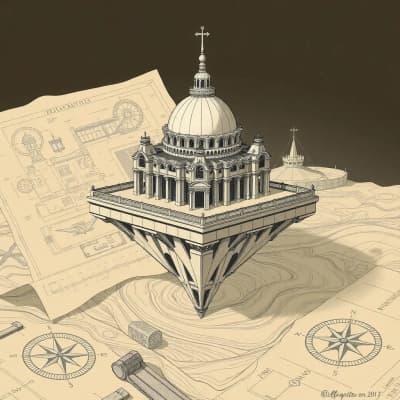
Error CorrectionWhy We Build Systems, Not CertaintyNarrator Imagine searching for solid ground to build your dream garden, only to discover that beneath your feet, there is nothing but air.Timmy Wait, Mrs. Parker, how do I build anything if there’s no solid ground?Mrs. Parker Timmy, the trick isn’t finding perfect ground—it’s building a way to learn from every wobble and slip!Narrator So, instead of fearing mistakes, we treat them as essential blueprints for improvement.Mrs. Parker Democracy, science, free speech—these aren’t just nice decorations! They’re systems designed to catch and fix errors before they become disasters.Timmy So, when something goes wrong, it’s not the end?Mrs. Parker Exactly! In the future, the best ideas rise and fall, like stocks. The system keeps updating, so we get less wrong with every step.Narrator But instead of fighting over the whole garden, people build their own beautiful corners, always improving, always learning.Plot: We look for something solid to stand and build on. There is no solid ground. We are floating. And that is okay. The goal isn't to find the perfect foundation; the goal is to build systems of error correction. Mistakes aren't failures of the system; they are the data points required for the system to update. Move mistakes from the "fatal" realm to the "theoretical" realm. We want our theories to die in our place. The systems we have, democracy, science, and free speech are not "nice to haves", they are distributed error-correction algorithms. They allow bad ideas to be killed off before they kill us. Knowledge is not a settled state of "being right." It is the dynamic process of "being less wrong." The moment you think you have arrived at the Absolute Truth, you stop correcting errors, and you stop learning. Stop looking for a guru. Stop trusting your gut implicitly. Build a system that aggressively hunts for your own errors and corrects them. That is the only path to perpetual improvement. Utopia is not a destination; it is a mechanism. In the future, competence will flow dynamically to where it is needed. The "legislature" is not a room of people; it is a real-time, shifting graph of trust and expertise. Prediction Markets work as Policy Engines The policy with the highest market confidence gets executed automatically. Legislation is written in a formal, verifiable language. The "Constitution" isn't a dusty document; it's the main branch of the repo. The future of government in an AI world is Polycentric Law. Physical land is static, but overlay jurisdictions are fluid, relying on Zero-Knowledge Proofs (ZKPs) to verify trust without sacrificing privacy. If one "provider" fails to correct errors, you unsubscribe. The cost of exit drops to near zero. Improving competition makes the entire system resilient. Competition loves specialization. If you can’t specialize, you go bankrupt, you don’t go to war. Communities form online first around shared values, gather resources, then crowdfund physical territory to enact their specific legal code. Stagnation becomes impossible! We stop fighting over "who gets to rule the whole world" and start competing over "who can build the best small corner of it." @Timmy: Resourceful 8yr old @Mrs. Parker: Unpredictable Examiner +Theme: Rendered in the style of architectural illustration, characterized by precise linework and detailed, structured compositions. The use of muted earth tones and subtle shading enhances the dimensionality and clarity of the structures. The design incorporates ornate detailing and a harmonious blend of classical and modern architectural elements, emphasizing symmetry and balance.